

A Comprehensive Guide To Prenatal Paternity Testing
Questions about biological paternity can arise before a child is born. For some families, waiting until delivery may prolong uncertainty or delay important personal and legal decisions.
Quick Summary On Paternity Test During Pregnancy

For current pricing, turnaround time, and collection arrangements, visit the Prenatal Paternity Test Page or contact Labtest Zote for a confidential consultation.
This guide explains how prenatal paternity testing works, when it can be performed, its accuracy and limitations, and what families in Kenya should consider before proceeding.
What is a Non-Invasive Prenatal Paternity Test?
A Non-Invasive Prenatal Paternity Test is a DNA test used to assess biological paternity while a pregnancy is still ongoing.

NIPPT can establish paternity during pregnancy using cell-free DNA found in the mother’s blood. At Labtest Zote, we test from 10 weeks of pregnancy. See the NIPPT product page for current pricing, sample requirements, and turnaround time.
During pregnancy, small fragments of DNA associated with the pregnancy circulate in the mother’s bloodstream. Most of this cell-free DNA originates from the placenta and usually reflects the unborn child’s genetic profile. A specialised laboratory can analyse these fragments and compare the genetic information with DNA from the mother and alleged father.
Reasons Why a Prenatal Paternity Test Is Done
A prenatal paternity test may be requested for personal reassurance or because the result is intended for an official process. Understanding the intended use before testing is important because a peace-of-mind test and a legal test may involve different sample-collection and documentation requirements.
| Peace-of-mind | Legal use cases |
|---|---|
| ☑Resolving uncertainty during pregnancy: Establishing biological paternity without waiting until the baby is born. | ⚖Court proceedings: Providing evidence in a parentage dispute where prenatal results are relevant and accepted by the court. |
| ☑Preparing for the child’s arrival: Helping the individuals involved make informed personal, family and financial plans. | ⚖Immigration or citizenship applications: Demonstrating a biological relationship when required by an embassy, immigration authority or other government agency. |
| ☑Clarifying more than one possible father: Comparing the unborn baby’s DNA with one or more alleged fathers | ⚖Parental responsibility and support matters: Supporting legal processes involving parental obligations, maintenance or custody after appropriate legal advice. |
| ☑Confirming parentage in a surrogacy arrangement: Verifying that the intended sperm provider is the biological father, where the laboratory method is suitable. | ⚖Inheritance and succession planning: Establishing biological relationships that may later be relevant to inheritance or succession proceedings. |
| ☑Reducing prolonged uncertainty: Providing an answer earlier in pregnancy so that those involved can consider their next steps with greater clarity. | ⚖Official documentation: Supporting applications or proceedings in which formally verified proof of biological paternity is required. |
Important: A prenatal paternity result is not automatically suitable for legal use. Legal testing may require verified identification, witnessed sample collection, tamper-evident packaging and a documented chain of custody. Requirements can differ between courts, countries, embassies and immigration authorities, so clients should confirm the applicable requirements before samples are collected.
How does prenatal paternity testing work?
A child inherits approximately half of their DNA from their biological mother and half from their biological father. NIPPT uses this principle to investigate paternity.
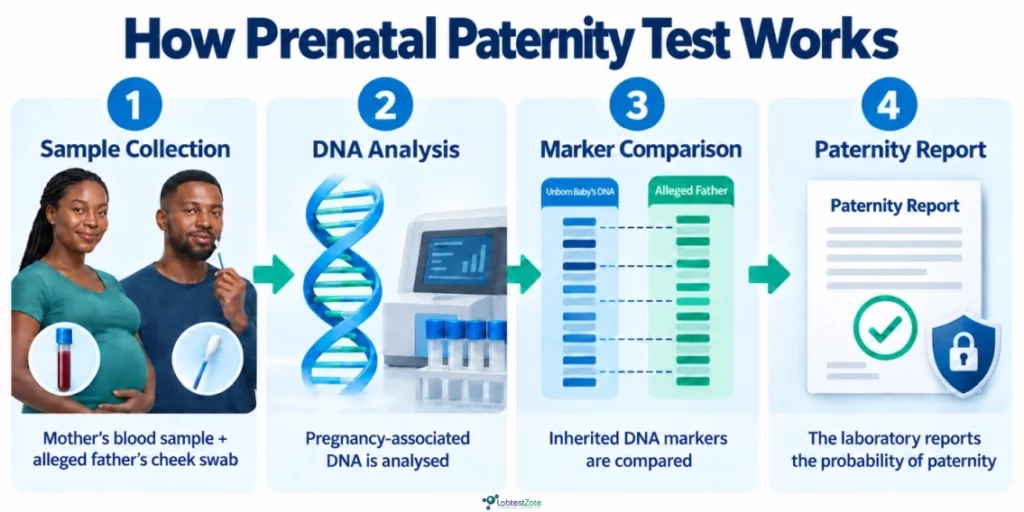
The process can be summarised in four stages (Click + to open each step)
- A blood sample is collected from the pregnant mother.
- A cheek swab is collected from the mother
- A cheek swab is collected from the alleged father.
- Mother’s DNA profile is generated from her mouth swab sample
- Mother’s blood sample is analysed for cell-free DNA. Using sophisticated molecular techniques, the unborn baby’s DNA is separated from the mother’s. The mother’s DNA profile generated in step one provides a backdrop for the computer algorithm to separate her DNA from the baby’s
- The alleged father(s)’ DNA profile is generated from his mouth swab sample
- The system then compares the baby’s DNA profile with the father to determine if they are biologically related.
- Using the data generated by the profile analysis, a complex computer algorithm ( known broadly as bioinformatics) calculates the probability that the baby and the tested father are biologically related. It does this by comparing their genetic profile against the expected results from a huge pooled database.
- Once the system confirms all the data is accurate and has passed all quality control measures, a report is issued. The molecular scientist counterchecks the report and hands it to the Lab Manager, who certifies it for release.

NIPPT Vs NIPT: Know The Difference!
The similar abbreviations sometimes cause confusion:
- NIPPT means Non-Invasive Prenatal Paternity Test. It examines DNA markers to determine biological paternity.
- NIPT means Non-Invasive Prenatal Testing. It is a prenatal screening test used to assess the chance of certain chromosomal conditions.
Although both tests analyse cell-free DNA from a maternal blood sample, they answer completely different questions. A paternity test does not screen the pregnancy for Down syndrome or other chromosomal conditions, while a routine NIPT does not identify the biological father.
When can NIPPT be performed?
The earliest testing time depends on the laboratory method and the amount of pregnancy-associated DNA present in the mother’s blood. Labtest Zote currently recommends testing from 10 completed weeks of pregnancy.

The proportion of pregnancy-associated DNA within the blood sample is called the fetal fraction. If it is too low, the laboratory may request another maternal blood sample after the pregnancy has progressed further.
Is a Non-Invasive Prenatal Paternity Test safe?
NIPPT requires an ordinary blood draw from the mother and a cheek swab from the alleged father. It therefore does not introduce the procedure-related pregnancy risks associated with invasive prenatal sampling.
This distinguishes it from:
- Chorionic villus sampling (CVS), which collects placental tissue.
- Amniocentesis, which collects amniotic fluid from around the fetus.
Key Advantages of Non-Invasive Sample Collection
- Eliminates the small but documented risk of pregnancy loss or miscarriage
- Eliminates the chance of introducing infection into the womb
- No need for a Gynaecologist to perform sample collection – Making it faster, convenient, and cheaper
CVS and amniocentesis are clinical procedures primarily used to diagnose certain genetic or chromosomal conditions. They should not be undertaken solely to establish paternity when a reliable non-invasive alternative is available. Discuss any decision about an invasive prenatal procedure with an obstetrician.
NIPPT uses a maternal blood sample and does not require a needle to enter the uterus, making it the safer approach when the only question is biological paternity.”
-Dr Joseph Mwaura
How accurate is prenatal paternity testing?
A properly conducted NIPPT can provide strong evidence either supporting or excluding paternity. The result should be interpreted according to the exact wording and probability reported by the analysing laboratory.
A typical report may state that:
“Not excluded” means that the genetic findings support the tested man being the biological father. It does not mean the laboratory merely failed to reach a decision—the accompanying probability and statistical calculations provide the strength of that conclusion.
Prospective clients should avoid relying on a general accuracy percentage alone. They should also ask about the laboratory’s validation, accreditation, quality controls, number of genetic markers examined and procedure for handling an inconclusive result.
Can a prenatal paternity test be inconclusive?
Although most appropriately timed tests produce a result, no responsible laboratory should guarantee that every initial sample will be conclusive.
A repeat sample may be required because of:
Blood transfusions, organ or bone-marrow transplants, surrogacy, egg donation and other circumstances that may affect DNA interpretation should be disclosed before testing. The laboratory can then determine whether its method is suitable.
If two possible fathers are closely related—for example, brothers—this must also be disclosed. Testing both men may be necessary to distinguish between them reliably.
If the first analysis is inconclusive, a new maternal sample may be requested. Under the current laboratory policy, testing may be repeated with newly collected samples up to two additional times where necessary.
The repeat laboratory analysis is covered, but the client remains responsible for any additional sample-collection and shipping costs. If three testing attempts have been completed without obtaining a conclusive result, a 50% refund of the test fee applies. Sample-collection and shipping costs are excluded from the refund.
Our team will explain the applicable terms before testing begins.
Important Things To disclose During your Appointment call
FEATURED TEST
Prenatal Paternity Test
 Original price was: KSh199,000.00.KSh179,000.00Current price is: KSh179,000.00.
Peace-of-mind testing versus legal testing
Before arranging NIPPT, decide how the result is likely to be used.
A peace-of-mind test is intended for private information and personal decision-making. A legal test requires stricter safeguards to demonstrate that the samples genuinely came from the identified participants.

Important Components of A Legal Prenatal Paternity Test
Do not assume that a privately collected test will later be accepted as legal evidence. If the result may be used in a court case, citizenship application or immigration process, explain this to the laboratory before collection. For immigration matters, confirm the receiving authority’s requirements before ordering; some authorities only accept reports from specific contracted laboratories, or those with specific home country accreditation.
Choosing a reliable NIPPT provider
Prenatal paternity testing is technically more complex than paternity testing after birth. A provider should be willing to explain:
- the earliest accepted gestational age;
- where the DNA analysis is performed;
- the analysing laboratory’s accreditation and quality standards;
- whether the test is suitable for twins or related alleged fathers;
- how identity and chain of custody are managed;
- what the final report will contain;
- how inconclusive results and repeat collections are handled;
- how samples and personal information are protected; and
- the complete cost and expected turnaround time.
A consultation before payment is particularly valuable. It helps establish whether the test is technically appropriate and whether the collection process matches the intended use of the result.
Choosing a prenatal paternity testing provider?
Download our printable checklist of 10 important questions to ask before paying or submitting your samples.
What happens after receiving the result?
Ready For Your Non-Invasive Prenatal Paternity Test?
Labtest Zote coordinates NIPPT sample collection in Kenya and provides pre-test guidance so that clients understand the timing, documentation, costs and limitations before proceeding.
For current pricing, detailed sample requirements, turnaround time, and ordering information, visit the Non-Invasive Prenatal Paternity Test product page or contact Labtest Zote Diagnostics for a confidential consultation.
Get in touch:-
Call or WhatsApp: 0711 902565
Email Address: dnatesting[@]labtestzote.com
Visit us:
Labtest Zote Diagnostics
Hurlingham Court, 1st Floor, Suite #18
Argwings Kodhek Road,
Nairobi, Kenya
References and Additional Resources
Disclaimer
This article is for informational purposes only. It does not replace the need for medical or legal advice